
 How a Leaking Building Envelope and Thermal Boundary Cause Humidity and Mold Problems
A building envelope that isn't properly air-sealed, insulated, or protected against moisture intrusion can contribute to elevated indoor humidity, condensation, moisture buildup, and mold growth.
The building envelope should have four important control layers:
- Water control layer: Prevents rainwater from entering the building and directs water to the exterior.
- Air control layer: Limits uncontrolled air movement through walls, ceilings, floors, and other building assemblies.
- Thermal control layer: Insulation reduces heat transfer and helps maintain interior surface temperatures.
- Vapor control layer: Manages water vapor diffusion and allows appropriate drying of the building assembly.
A leaking building envelope can allow humid air, groundwater moisture, and rainwater to enter a building through defects in its air, water, vapor, and thermal control layers.
How air leakage creates moisture problems
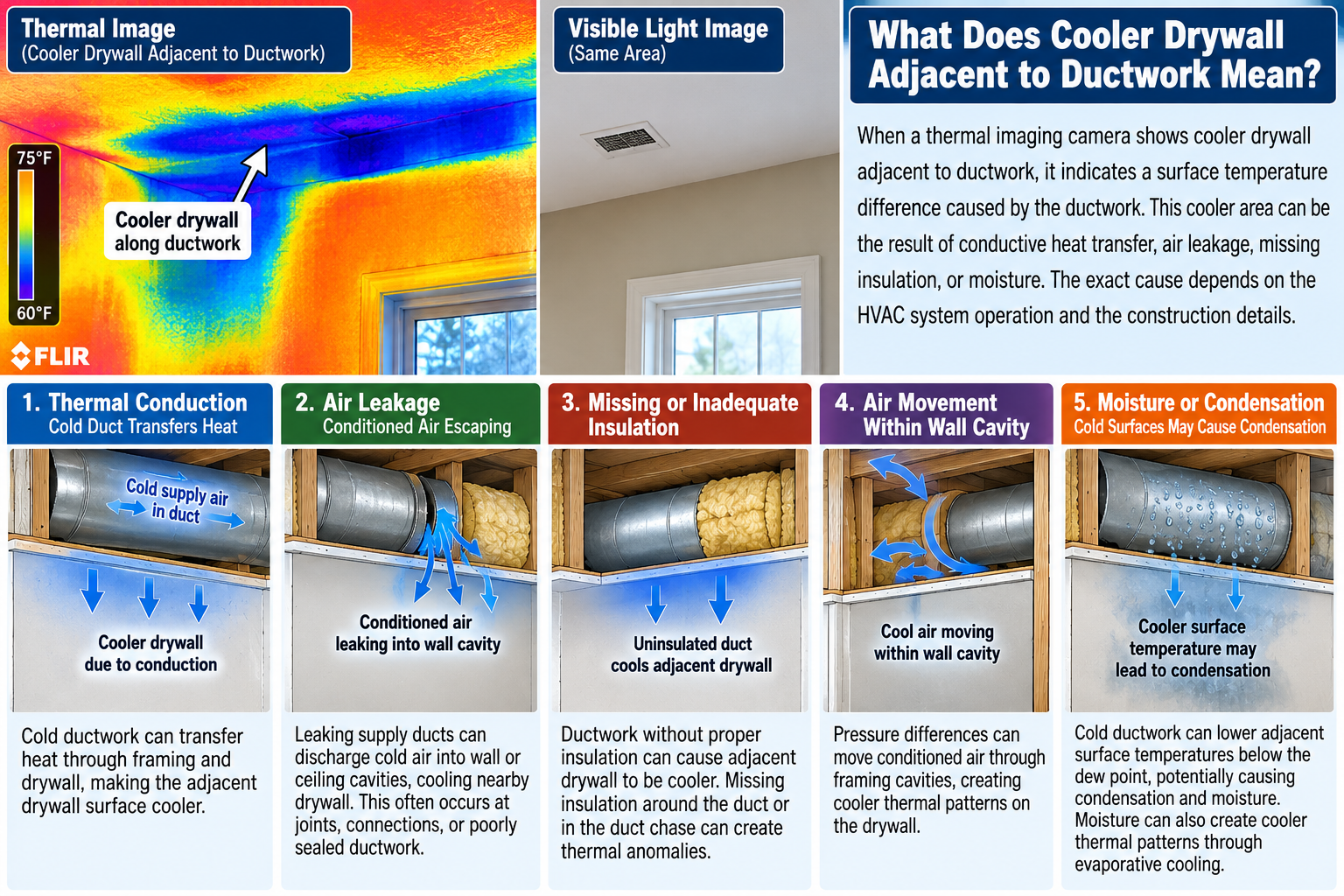
During hot, humid weather, outdoor air can enter a conditioned building through gaps around windows, doors, electrical penetrations, recessed lights, fire suppression heads, rim joists, attic connections, and HVAC duct chases. Condensation forming on the ductwork near an exterior rim joist can cause extensive moisture in the floor cavity. Smashed or kinked flex ductwork can reduce airflow and the R-value of the duct insulation, resulting in condensation. Ductwork too close to, or in contact with, roof sheathing or embedded in spray foam can also cause condensation in the ductwork.
When this humid air encounters cooler surfaces inside the building, its relative humidity increases. If the surface temperature reaches or falls below the air's dew point, condensation can develop.
During cold weather, the opposite can occur. Warm, humid indoor air may leak into cold exterior wall or roof assemblies, where condensation can form on sheathing or other cold surfaces.
Air leakage can transport substantially more moisture into concealed building cavities than vapor diffusion alone, depending on the leakage rate and environmental conditions.
How thermal boundary defects contribute to mold
Missing insulation, compressed insulation, thermal bridging, and discontinuous insulation can create localized cold surfaces.
These conditions can lead to:
- Condensation on drywall, framing, and sheathing.
- Elevated surface relative humidity, even without visible condensation.
- Moisture accumulation within insulation and wall cavities.
- Mold growth on paper-faced drywall, wood framing, and other susceptible materials.
- Deterioration of building materials when moisture exposure persists.
For example, indoor air at 75°F and 60% relative humidity has a dew point of approximately 60°F. If a wall surface falls below that temperature, condensation becomes possible. Mold growth can also occur at higher surface temperatures when surface humidity remains elevated for sufficient periods.
How to investigate these conditions
A professional building-envelope investigation should include thermal imaging, moisture measurements, indoor and outdoor temperature and humidity readings, and examination of accessible air and water control layers.
-door testing, combined with thermal imaging, can help locate air leakage pathways. Pressure diagnostics can also identify air movement between conditioned spaces, attics, crawlspaces, and duct systems.
Important: Thermal imaging identifies temperature differences, not mold or moisture directly. Cooler surfaces may indicate thermal bridging, missing insulation, air leakage, or moisture-related cooling. Findings should be verified using appropriate diagnostic methods.
The most effective corrective approach is to identify and repair the moisture source, restore continuity of the air and thermal boundaries, provide appropriate drainage and drying potential, and remediate mold-contaminated materials where necessary.
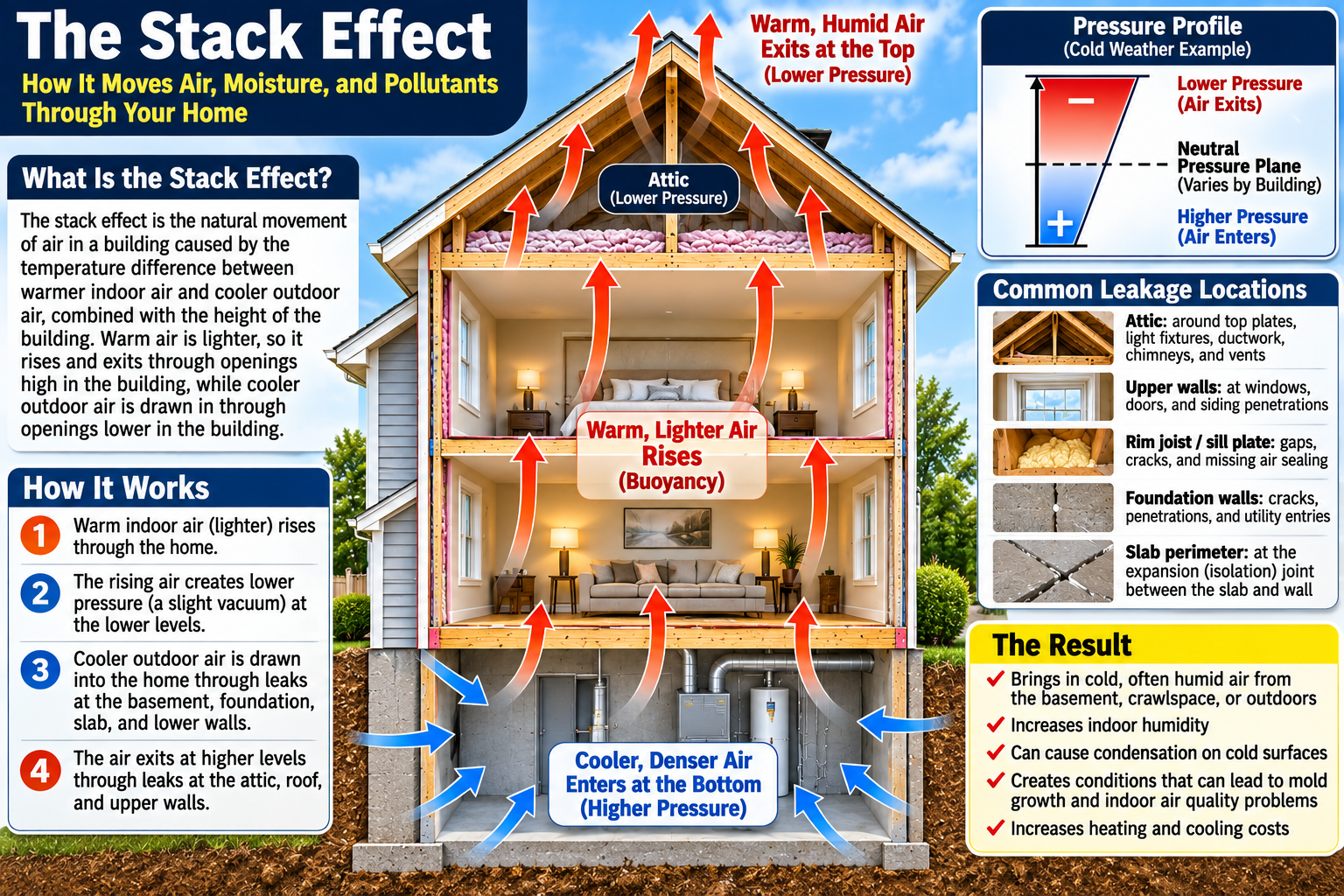
Basements and crawlspaces, foundation walls, rim joists, sill plates, and slab perimeter joints are particularly vulnerable because these areas are often exposed to ground moisture, air pressure differences, and thermal bridging.
Critical moisture and air leakage pathways
-
Foundation walls: Cracks, penetrations, and inadequate waterproofing can permit groundwater intrusion and moisture migration through concrete or masonry.
-
Rim joists and sill plates: Gaps and missing air sealing allow outdoor air to enter framing cavities. In humid weather, this air can condense against cooler basement surfaces.
-
Slab perimeter expansion or isolation joints: Unsealed gaps between the concrete slab and foundation wall can allow soil gases, water vapor, and humid air to enter the basement.
-
Basement wall penetrations: Plumbing, electrical, and HVAC penetrations can provide pathways for uncontrolled air and moisture movement.
-
Thermal boundary defects: Missing insulation and thermal bridging can lower surface temperatures, increasing surface relative humidity and the potential for condensation and mold.
-
Stack effect and HVAC pressure differences: Pressure differences can draw air from the soil, basement, crawlspace, or exterior into the building through these leakage pathways.
When these conditions persist, moisture can accumulate on wood framing, insulation, drywall, subflooring, and concealed wall surfaces, potentially supporting mold growth.
Important building-science considerations
The graphic illustrates potential air leakage pathways. Actual airflow direction depends on outdoor conditions, wind, stack effect, and HVAC operation. Basement air can move upward through a building, but leakage pathways can also reverse direction.
A properly constructed building envelope should include continuous air sealing at the foundation-to-framing connections, rim joists, and slab perimeter joints, together with appropriate insulation, foundation waterproofing, drainage, and vapor control.
Inspection recommendation: Use blower-door testing, thermal imaging, moisture meters, and indoor humidity measurements to identify deficiencies. In basements, investigate foundation moisture and soil-gas entry before sealing pathways; slab and foundation openings can also admit radon.
Correcting these defects can reduce unwanted moisture entry, improve indoor humidity control, and help prevent conditions conducive to mold growth.
