
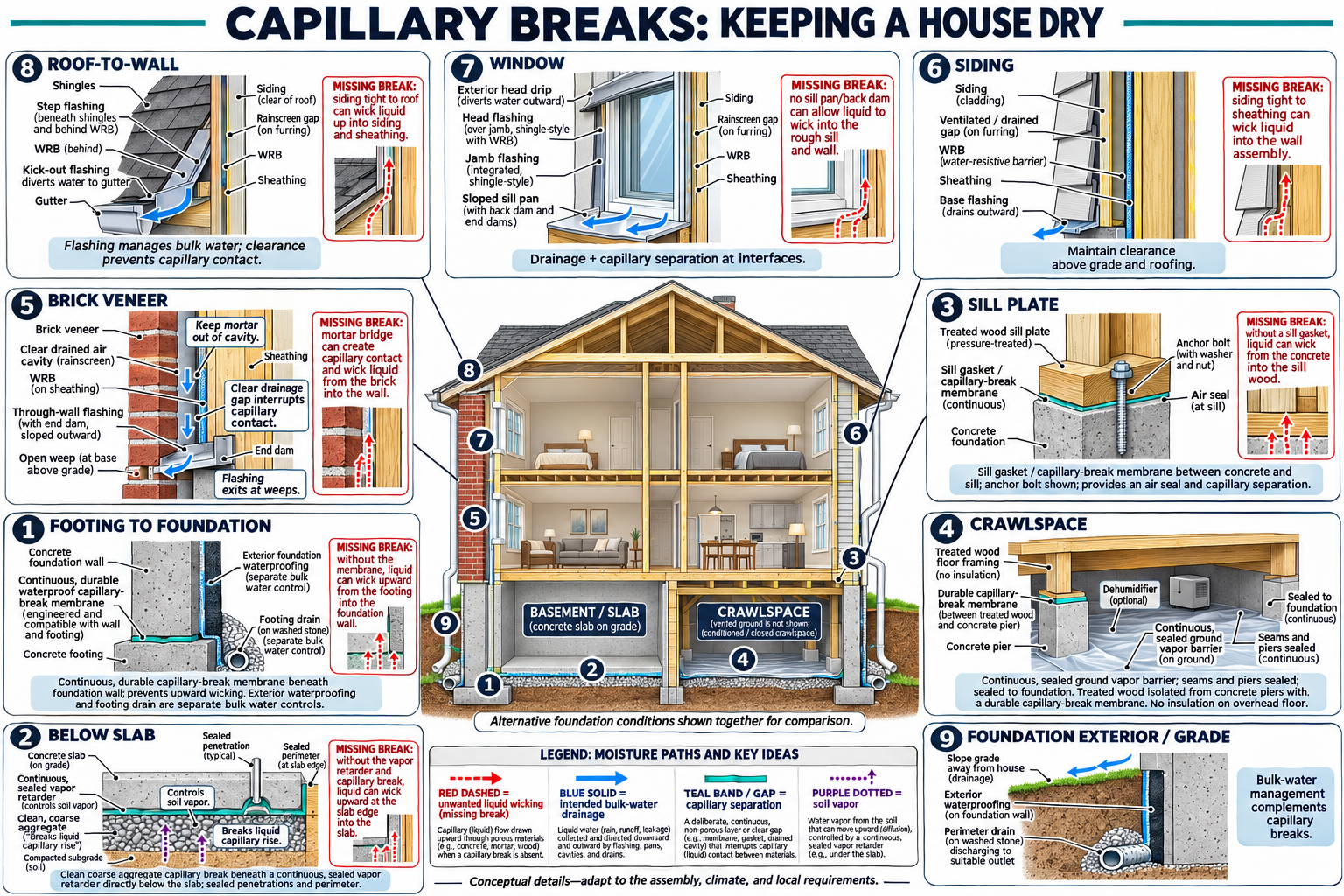
The Importance of Capillary Breaks in Residential Construction
Capillary breaks are one of the most important components of a properly designed building envelope. They prevent liquid moisture from moving through porous building materials such as concrete, masonry, brick, mortar, wood, and certain insulation materials.
Without effective capillary breaks, moisture can migrate from the soil, foundation, masonry, and other wet materials into the home's structural components, contributing to deterioration, elevated moisture levels, mold growth, and reduced building durability.
What is capillary action?
Capillary action, also called capillary suction or wicking, occurs when liquid water moves through small interconnected pores in building materials. Water can move upward, horizontally, or downward, depending on the material's pore structure and moisture conditions.
For example, a concrete foundation can absorb groundwater and transport moisture upward into a wood sill plate if there is no effective capillary break separating the two materials.
A capillary break interrupts this liquid-water pathway using a nonabsorbent material, a properly detailed membrane, or an air gap.
Important distinction: A capillary break controls liquid water movement. It does not necessarily stop water vapor diffusion, air leakage, or water under hydrostatic pressure. These require additional moisture-control measures.
1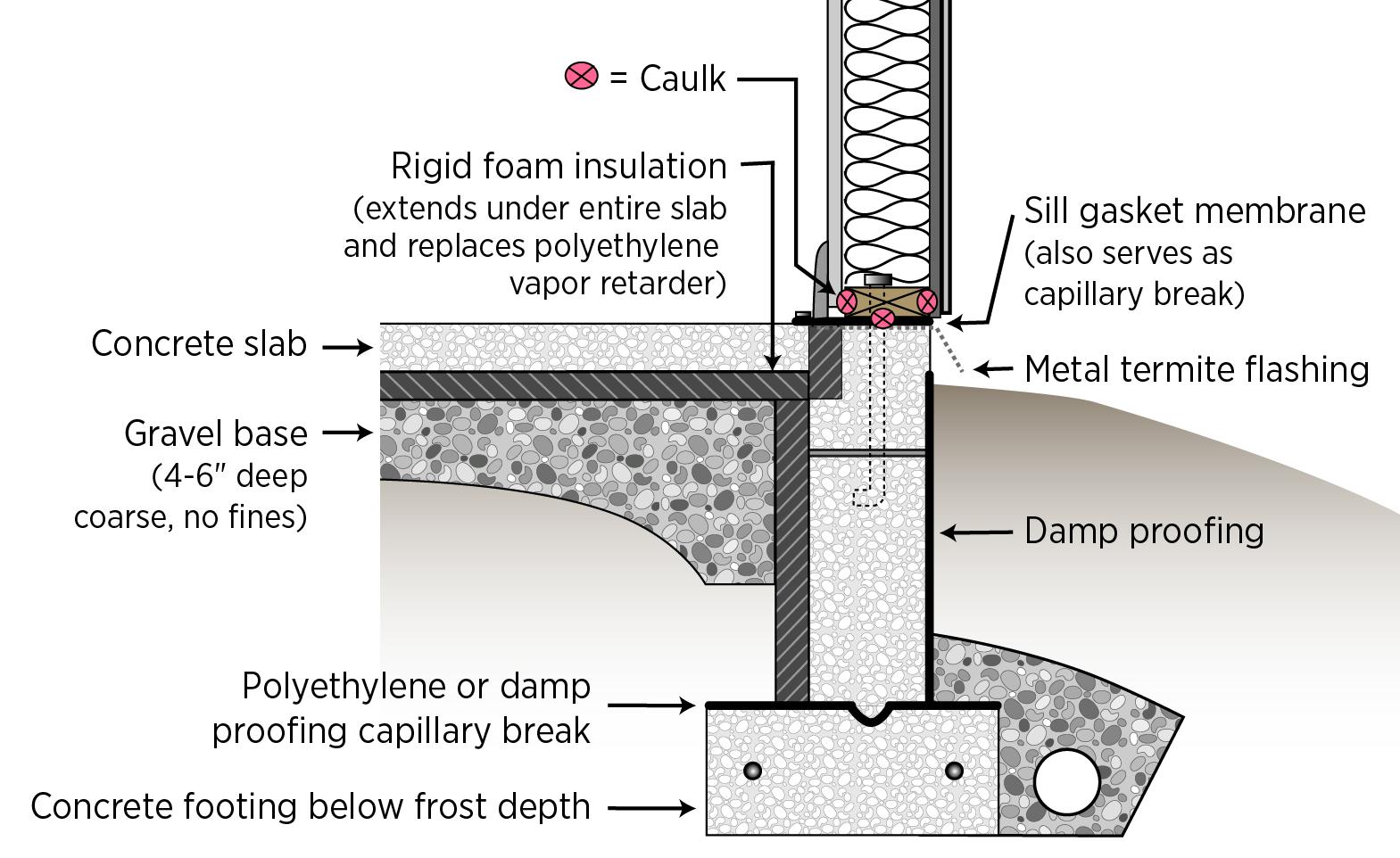 . Foundation capillary breaks
The foundation is one of the most critical locations for capillary breaks because concrete and masonry are frequently exposed to moisture from the surrounding soil.
A properly designed foundation should incorporate:
- Between the concrete foundation and wood sill plate: A continuous, compatible capillary break such as an appropriate sill gasket, membrane, or waterproofing material to prevent moisture transfer into the framing.
- Under the concrete slab: A clean, coarse aggregate layer that interrupts capillary rise from the soil, combined with a properly sealed vapor retarder directly beneath the slab where required by the assembly design.
- At foundation walls: Exterior waterproofing or damp-proofing, drainage provisions, and appropriately detailed materials that reduce water absorption and moisture transmission.
- At foundation footings: Where appropriate, a capillary break between the footing and foundation wall to reduce upward moisture migration.
Without these protections, moisture can wick into concrete and masonry, increasing the risk of wet sill plates, damaged floor framing, efflorescence, and elevated crawlspace or basement humidity.
2. Wall assemblies and exterior cladding
Exterior walls need to manage both bulk water intrusion and capillary moisture movement.
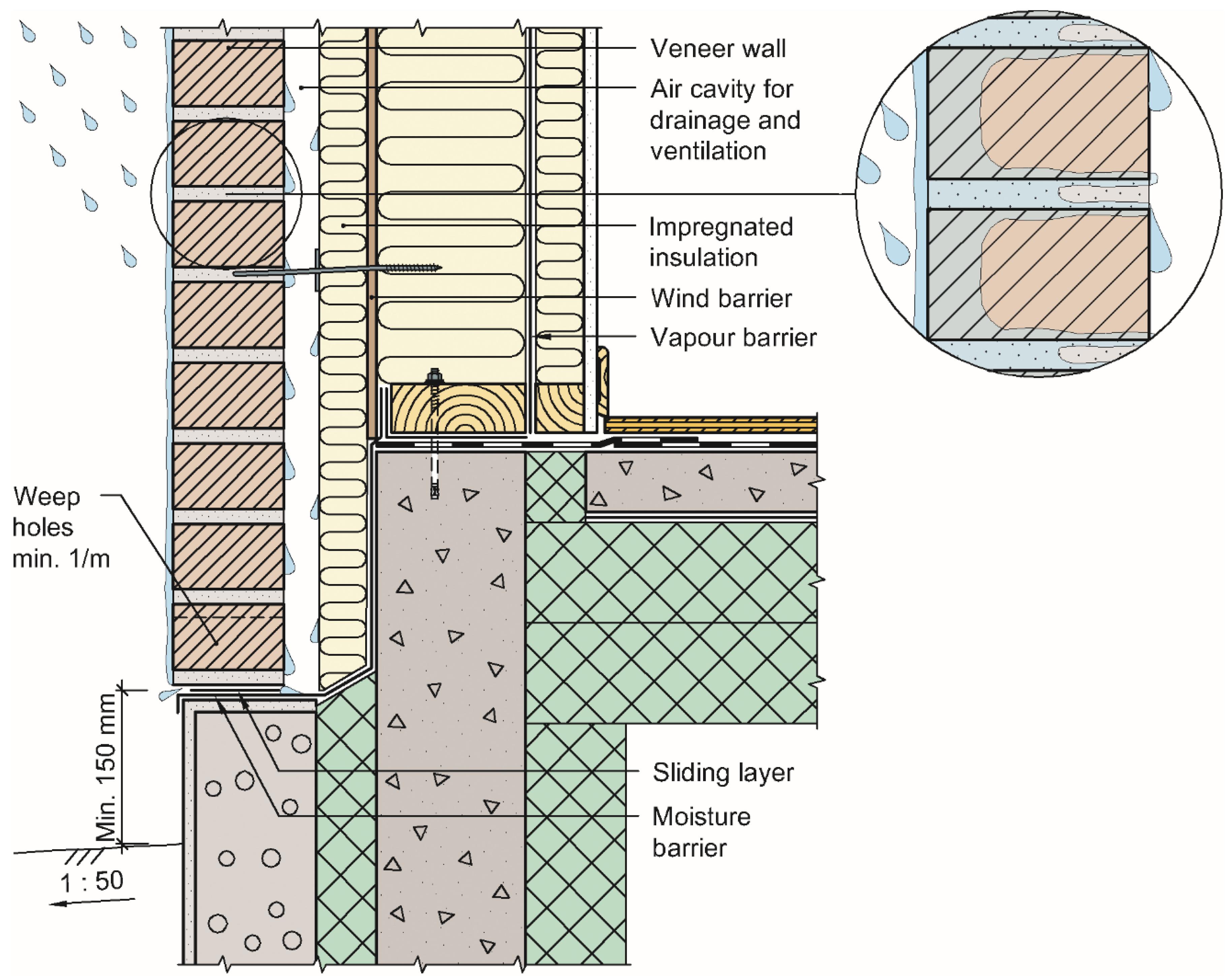
In a properly constructed wall assembly, capillary breaks are particularly important at:
- Brick veneer: A drainage cavity separates the brick from the sheathing and water-resistive barrier. Flashing and weep openings allow collected water to escape.
- Wood siding: A rainscreen drainage gap can prevent wet siding from remaining in direct contact with the water-resistive barrier.
- Stucco: An appropriate drainage mat, drainage space, or other code-compliant drainage assembly can help separate wet stucco from moisture-sensitive materials.
- Masonry-to-wood transitions: Membranes or other nonabsorbent separators reduce moisture transfer between masonry and wood framing.
- Wall bases: Properly integrated flashing directs water outward rather than allowing it to accumulate at the bottom of the wall.
A capillary break is particularly important behind reservoir claddings such as brick, stucco, and adhered masonry, which can absorb and store rainwater.
3. Floors, crawlspaces, and slab edges
Floor systems can experience moisture damage when capillary movement is not controlled.
Important locations include:
- Concrete slab to flooring: Moisture-sensitive floor coverings may require an appropriate slab vapor-control system and moisture testing before installation.
- Crawlspace floors: A continuous, sealed ground vapor retarder limits soil moisture evaporation into the crawlspace. The ground assembly should also address capillary water movement.
- Wood framing supported by masonry: Appropriate separators help prevent moisture from wicking into joists, beams, and bearing plates.
- Slab perimeters: Proper detailing limits moisture transfer at slab edges, walls, and transitions.
A polyethylene ground cover is an important vapor-control component, but it is not a substitute for drainage or waterproofing where liquid water is entering the crawlspace.
4. Windows, doors, decks, and roof connections
Capillary moisture transfer also occurs at smaller building-envelope connections.
Windows and doors: Sloped sill pans, end dams, drainage paths, and compatible flashing prevent water from remaining trapped against framing. Drainage gaps and material separation can also interrupt capillary contact.
Deck connections: Flashing and appropriate separation between the deck ledger and wall assembly reduce moisture retention and wicking into wood framing.
Roof-to-wall intersections: Kickout flashing, step flashing, and properly integrated drainage planes direct rainwater away from the wall assembly. These primarily control bulk water, while separation and drainage spaces help reduce capillary moisture transfer.
Exterior trim: Maintaining proper clearance from roofing, masonry, soil, and other wet surfaces helps prevent wood trim and siding from absorbing moisture.
5. Common capillary-break failures
| Location |
Foundation sill
Under slab
Brick veneer
Stucco walls
Crawlspace
Wood siding
Window openings
Deck ledger
| Missing or defective detail |
No effective moisture separator
No capillary aggregate layer
Mortar bridges across cavity
No effective drainage separation
Exposed soil and poor drainage
Direct contact with wet masonry
Improper sill flashing
Improper flashing or separation
| Potential consequence |
Wet sill plates, wood decay
Upward moisture migration
Moisture transfer toward sheathing
Moisture retention and deterioration
Elevated humidity, condensation risk
Wicking and wood decay
Wet framing and concealed damage
Moisture intrusion and framing decay
6. Why capillary breaks matter in building-envelope investigations
During a building-envelope or moisture-intrusion investigation, capillary moisture migration should be evaluated separately from condensation, plumbing leaks, air leakage, and direct rainwater intrusion.
A comprehensive evaluation may include visual examination of material transitions, moisture mapping with appropriate meters, infrared thermography to locate thermal anomalies, and selective invasive examination when justified.
Thermal imaging cannot independently confirm capillary action or identify moisture. Suspected moisture-related anomalies must be correlated with material conditions and verified using appropriate moisture measurements.
7. The four primary moisture-control strategies
| Bulk water control Flashing, drainage, roofing and waterproofing |
Capillary control Material separation, membranes and drainage gaps |
| Air leakage control Continuous air barriers and sealed penetrations |
Vapor control Climate-appropriate vapor retarders and drying potential |
All four strategies must work together. Installing a vapor barrier without controlling liquid-water intrusion and capillary transport can still result in a wet building assembly. Conversely, installing impermeable materials in the wrong locations can restrict drying and trap moisture.
Conclusion
Capillary breaks are essential to building durability because they interrupt the movement of liquid water through porous materials. They are especially important at foundations, slabs, sill plates, masonry walls, exterior cladding, floor framing, and other material transitions.
For an existing house, the priority is to identify where capillary pathways exist, determine whether they are contributing to moisture damage, and select corrective measures that preserve drainage and drying potential.
